 Hexalian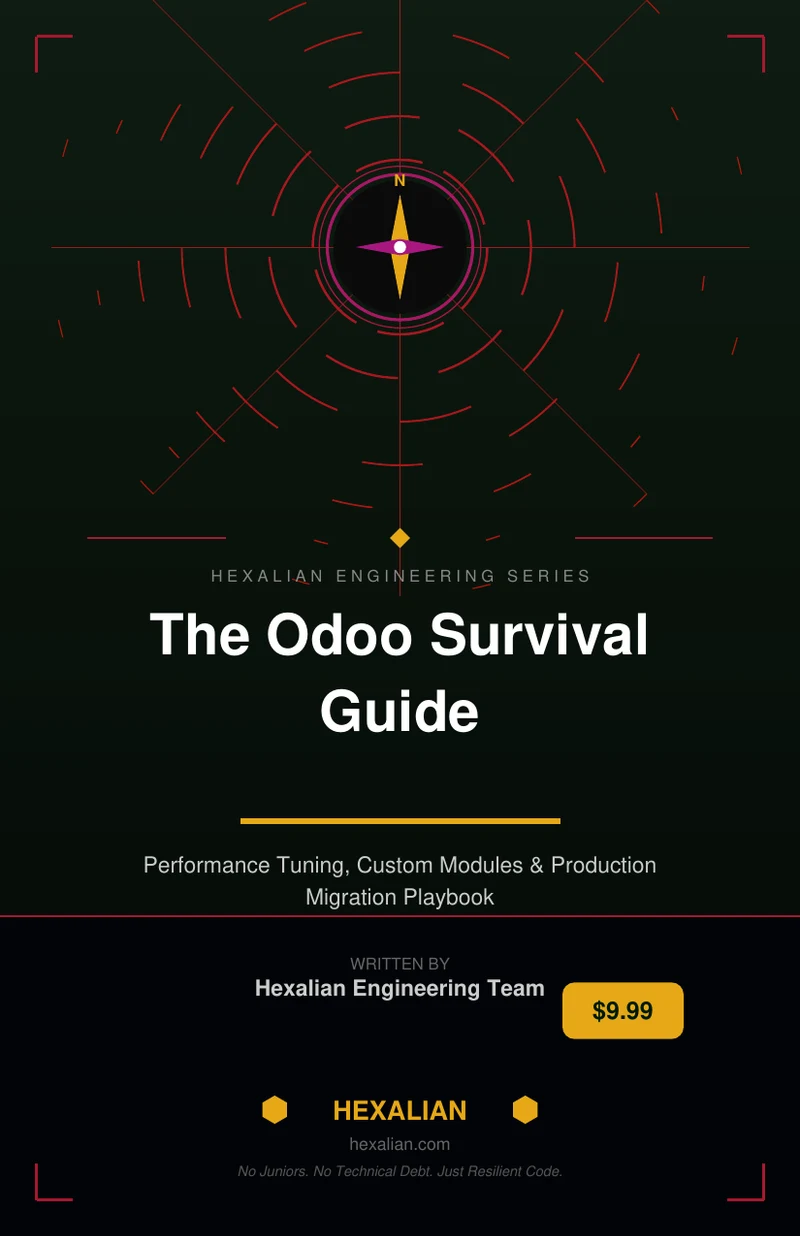
Odoo Survival Guide
The Odoo Survival Guide is a practical playbook that helps developers, technical leads, and CTOs run Odoo in production with confidence. It covers architecture, upgrades, and day‑two operations from engineers who ship Odoo every week.
Get the full PDF: Odoo Survival Guide
View book & download →Introduction
Odoo is an all‑in‑one ERP that promises to streamline finance, sales, inventory, and more. Yet many organizations discover that the very system designed to simplify operations becomes a source of frustration when it starts to lag, crash, or refuse to upgrade. The Odoo Survival Guide is a practical playbook that tackles those pain points head‑on. It distills the experience of Hexalian engineers who audit over 40 production deployments, turning anecdotal fixes into repeatable best practices. Whether you’re a developer, technical lead, or CTO, this guide will help you avoid the common pitfalls that turn Odoo into a maintenance nightmare.
What Odoo Survival Guide Covers
The book is structured around the most critical decisions you make when deploying or scaling Odoo. From the outset, it answers the question: What does the Odoo Survival Guide solve, and who is it for? In two to three sentences, the guide explains that it provides a step‑by‑step framework for diagnosing deployment failures, tuning PostgreSQL, writing resilient code, and architecting custom modules that survive upgrades. It is designed for practitioners who need a clear, actionable roadmap to keep Odoo running smoothly in production.
Deep Dive: PostgreSQL Optimization
PostgreSQL is the heart of Odoo’s data layer, yet most deployments treat it as a black box. The guide dives into the database tuning that turns a sluggish instance into a high‑performance engine. You’ll learn how to configure shared buffers, work memory, and autovacuum thresholds to match your workload. The book also covers indexing strategies tailored to Odoo’s ORM, explaining when to use partial indexes, expression indexes, or multi‑column composites. By the end of this section, you will have a checklist of PostgreSQL parameters that can shave seconds off query times, reduce lock contention, and keep your database healthy during peak load.
Deep Dive: Custom Module Architecture
Custom code is often the source of future headaches. The guide examines the patterns that make or break a module’s long‑term maintainability. It covers the importance of modular design, clear API boundaries, and the use of abstract models to avoid tight coupling. You’ll discover how to structure your code so that future upgrades can be applied without breaking custom logic, and how to write tests that guard against regressions. The section also includes a step‑by‑step walkthrough of creating a reusable library that can be shared across projects, turning bespoke functionality into a potential revenue stream.
Practical Checklist You Can Use This Week
- Database Health – Run
VACUUM ANALYZEon critical tables and reviewpg_stat_activityfor long‑running queries. - Index Audit – Use
pg_indexto identify unused indexes and drop them to reduce write overhead. - Code Review – Scan custom modules for ORM misuse: avoid
read()in loops, prefersearch_read()where appropriate. - Upgrade Readiness – Ensure all custom modules have a
__manifest__.pywith a properdependslist and version constraints. - Backup Strategy – Verify that automated nightly backups include both database and filestore, and test restore in a staging environment.
- Monitoring – Deploy a lightweight Prometheus exporter for PostgreSQL and Odoo logs; set alerts for latency spikes.
Apply this checklist before your next sprint to catch issues that could explode into production crises.
Odoo Production Notes
Running Odoo in production is not just about deploying code; it’s about establishing a resilient ecosystem. The guide outlines the architecture of a scalable Odoo deployment, from load‑balanced web servers to clustered PostgreSQL instances. It explains how to configure Nginx as a reverse proxy, set up Redis for session storage, and use Celery for background jobs. The book also discusses the importance of separating the filestore from the database to simplify scaling and backups. Finally, it covers day‑two operations: monitoring, patching, and performing safe upgrades without downtime.
Who Should Read This
- Odoo developers and technical leads who manage production instances and need a framework to diagnose and fix performance issues.
- Implementation partners seeking to reduce day‑two firefights and deliver a stable product to clients.
- CTOs and IT managers evaluating whether their current Odoo stack can support growth to 1,000+ concurrent users.
- Consultants who want to turn their expertise into a revenue stream by offering modular solutions built on best‑practice patterns.
Conclusion
The Odoo Survival Guide is more than a manual; it’s a field‑tested playbook that turns the chaos of production into a predictable, manageable process. By mastering PostgreSQL tuning, writing resilient code, and architecting custom modules with future upgrades in mind, you’ll transform Odoo from a potential bottleneck into a scalable, business‑enabling platform. Ready to take your Odoo deployment to the next level?
Get Odoo Survival Guide — $9.99 PDF (instant download) →
Browse Odoo modules at hexalian.com/store or explore our engineering eBooks.
Running Odoo in production?
Get Odoo modules with full source code, or talk to us about custom development and hardening.